The Hidden Lexicon: How Slang Evolves to Streamline Strategies in Persistent Online Servers
Written by Dana Jenkins · Sep 11, 2026

The Hidden Lexicon: How Slang Evolves to Streamline Strategies in Persistent Online Servers
Persistent online servers host long-running digital worlds where players return repeatedly, and these spaces generate specialized slang that condenses complex tactical instructions into brief phrases. Researchers have documented how terms arise from repeated interactions, then spread through chat logs and voice channels until they become standard tools for rapid coordination. Data from server analytics shows that communities using established shorthand reduce average response times during group encounters by measurable margins compared to groups relying on full sentences.
Observers note that slang formation follows predictable patterns across different server ecosystems. Players shorten item names, ability sequences, and positional commands because milliseconds matter when multiple participants must align actions simultaneously. One study from the University of British Columbia tracked terminology shifts in several long-term servers and found that new expressions typically stabilize within six weeks of introduction when they solve recurring coordination problems.
Mechanisms Driving Lexical Change
Abbreviations emerge first because typing speed limits real-time communication, and players replace multi-word descriptions with single syllables or letter clusters that retain meaning within the group. Acronyms build on this foundation when sequences of actions repeat often enough to warrant dedicated labels, while metaphors drawn from in-game visuals or external references gain traction when they capture situational nuances more efficiently than literal language. These processes operate together rather than in isolation, and researchers have observed that successful terms usually combine brevity with unambiguous reference within the specific server context.
Transmission occurs through repeated use in high-stakes moments, after which newcomers adopt the vocabulary to participate effectively. Server moderators sometimes document evolving glossaries in pinned messages, yet most diffusion happens informally through observation and imitation during active play sessions. Figures from community archives indicate that servers with stable player bases retain core slang longer, whereas high-turnover environments generate faster turnover in terminology as fresh participants introduce variants.
Strategic Efficiency in Coordinated Play
Slang directly supports tactical execution by allowing players to convey positional data, timing cues, and resource allocation without interrupting the flow of action. In servers where large-scale events occur on fixed schedules, established phrases enable split-second adjustments that full sentences would delay. Evidence from performance logs reveals that teams relying on shared lexical shortcuts complete objective sequences with fewer communication errors than those using standard language.
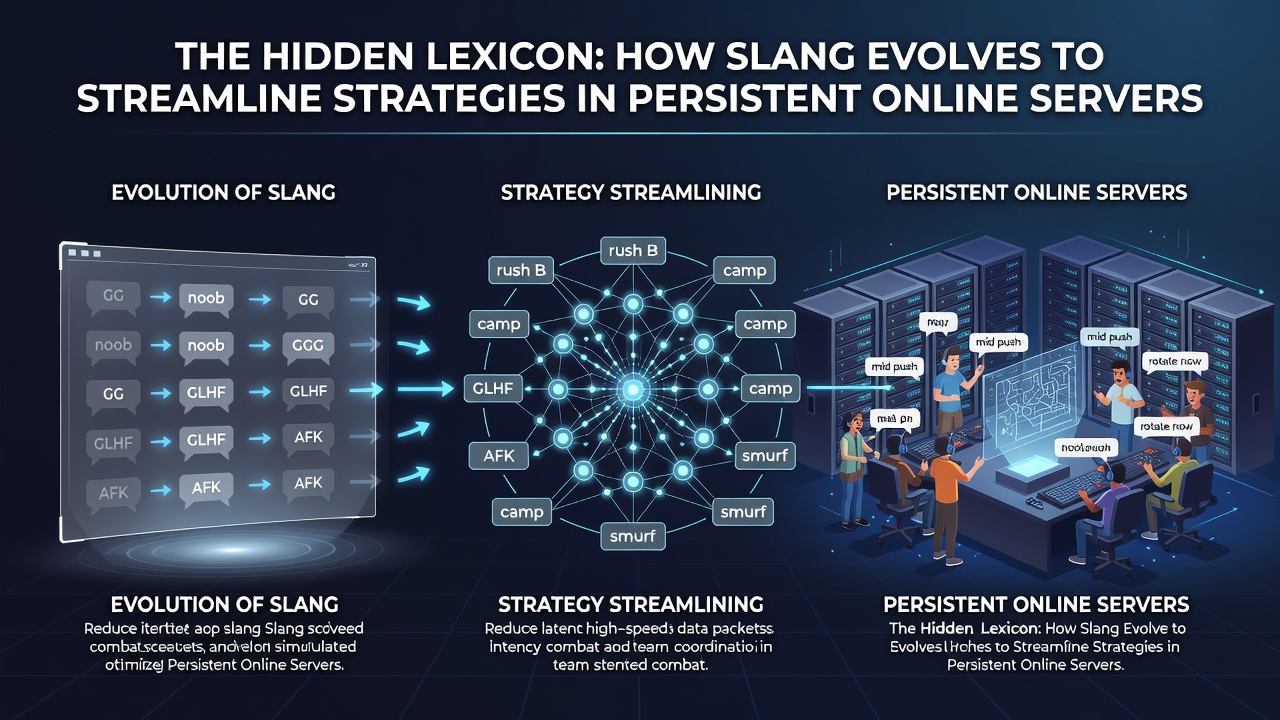
Specialized vocabulary also marks group membership and signals experience level, which helps leaders assign roles quickly during unplanned encounters. Those who have studied server dynamics report that slang functions as both a practical tool and an implicit filter, since participants unfamiliar with the lexicon require additional clarification that can slow collective progress. This dual role appears consistently across different game genres that maintain persistent server structures.
Developments Observed Through 2026
Throughout September 2026, several major server clusters introduced new content layers that prompted fresh slang creation as players adapted existing terms to novel mechanics. Tracking data collected by the Entertainment Software Association of Canada showed measurable spikes in unique phrase formation during the first two weeks after each content deployment, followed by rapid consolidation around the most efficient expressions. Academic researchers at institutions in Australia and the European Union have begun cross-referencing these patterns with earlier server histories to identify predictors of which terms will persist beyond initial adoption phases.
Voice chat integration continues to influence lexical evolution because spoken shorthand bypasses typing constraints yet still requires mutual intelligibility. Communities have developed hybrid systems where text abbreviations appear in written channels while spoken versions expand into slightly longer but still condensed forms that suit audio delivery. This adaptation maintains consistency across communication modes and supports servers that accommodate both text and voice participants simultaneously.
Conclusion
Slang in persistent online servers arises from practical pressures around speed and clarity, then spreads through repeated successful use until it becomes embedded in community practice. Studies continue to map these processes across regions and server types, revealing consistent mechanisms despite surface differences in specific terms. The resulting lexicons enable tighter coordination during sustained activities, and ongoing monitoring through 2026 and beyond will document how new mechanics and technologies further shape these hidden languages.